
The past is not past and the future is already here. Past and future, therefore, mix and mingle in the present. It follows then that the best way to see into the future is to harvest what the past has to teach us. Here we appropriately see a nurse tree, where the remnants of old growth provide the foundation, and sustenance, for new growth.
As I touched on previously, I have been dedicating an inexcusable amount of time to collecting past writings and project records into a digital knowledge archive that I can work with to harvest some useful lessons and to hopefully catch some glimpses into the future.
My most recent contribution to the archive was a registry of my past projects. Last night I arrived at a point of readiness where I could move my efforts from finalizing the project entries to analyzing them. I was happy to arrive at this point because the registry of project entries had already reached 100 individual projects. If that were not unsettling enough, a significant number of these projects stretched over a decade or more in duration. I was happy to reach some form of conclusion because the effort was proving to be a little sobering. So many projects. So many memories. So many stories. And yes, so many lessons. I struggled, late last night, to imagine how I might have been able to sustain so many projects. I am still struggling with this question.
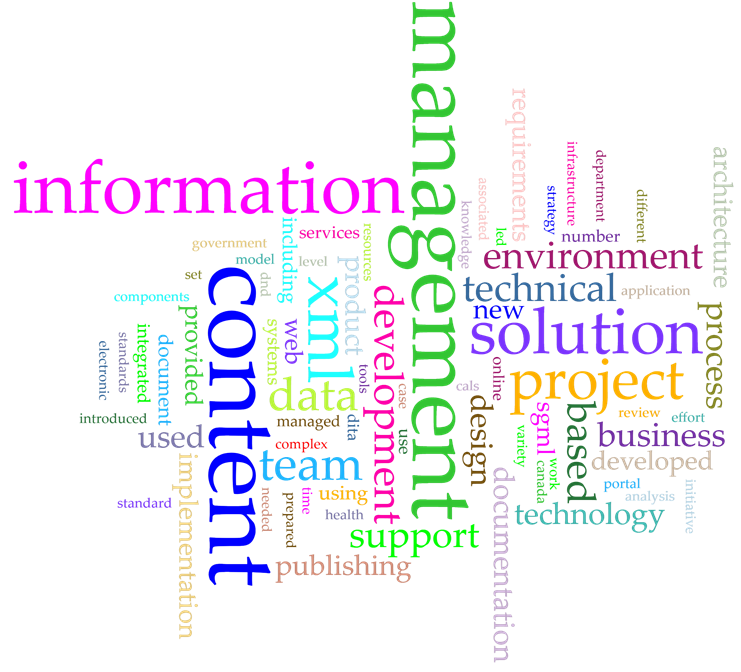
One of the tactics I am drawn to when confronted with a tsunami of details is called ‘distant reading’ where you step back from those details in an attempt to see larger patterns. Text visualizations often help to do this. In this case, I am using an academic text analytics platform called Voyant and one of its features allows you to drill down on selected terms using other visualizations and reports, and to go all the way back to their occurrences within the text. Above we have a word cloud of the top fifty (50) words in the descriptions of the 100 projects that I have undertaken, and in almost all cases managed, between 1989 and the present. We see the usual suspects here (in order of occurrence frequency): content, management, information, solution, project, XML, and data. It is telling that the next most common word is team. Certainly, it is true that all of these projects involved a team, and often groups of teams, working intensively together. Other frequently used words that seem relevant include: environment, business, process, architecture, requirements, implementation, and yes, even DITA and SGML.
Mixed with my own recollections, these keywords tell me something about these 100 projects. For one, they were almost always focused on realizing content solutions, applications that do something of strategic value for their organizations. Very few of the projects, by contrast, were focused on setting up a technical documentation team with what we might style a Content Ops environment. And in the few cases where this more limited focus may have been where things started, a closer inspection of the projects highlighted the fact that I immediately moved them towards being something more than just documentation projects.
Looking more closely at the above word cloud and the associated term concordance, I zeroed in on a few terms in particular. This is in fact how you use these types of text analytics tools. They don’t produce insights all by themselves. Rather they prompt you, as the researcher, to dig deep and to do the hard work of making the insights. In this case, I noticed words that I thought were noise such as ‘based’, ‘including’ and ‘associated’ and I was about to update my stop word list to remove them from the reports. But then I paused and looked at the terms more closely. Each of these words identifies a relationship. Something is ‘based’ on something else; it extends it or applies it. Also something ‘includes’ other things, which are then ‘included’. And something can be ‘associated’ with something else. Suddenly the ‘noise’ words became interesting.
Up at the level of the top terms, we see that we can pair them in different ways and by drilling down into in-context occurrences we can explore this further. But we can posit the following ‘smoking guns’: content management, information technology solution, technical environment, content solution, solution content, and management content. These are, again, interesting. I also noted that variations on the term ‘complex’ appear almost 70 times in the registry and in exploring the in-context occurrences I find that complexity is the number one challenge to be addressed by the projects - either in the business and technology landscape needing a solution or in the resulting solution (and in most cases both).
The title of this article comes to us from Anthropic’s Claude (Opus 5). Claude’s summation on my 45,000 word project registry landed perfectly: ‘One Solution, Invented One Hundred Times’. As a distillation of the project registry, it is uncomfortably accurate. As I shared with Claude, this phrasing would send many past colleagues, customers, and investors, into fits of laughter. It definitely elicited an outburst from me.
What is this one solution? Inquiring minds want to know.