


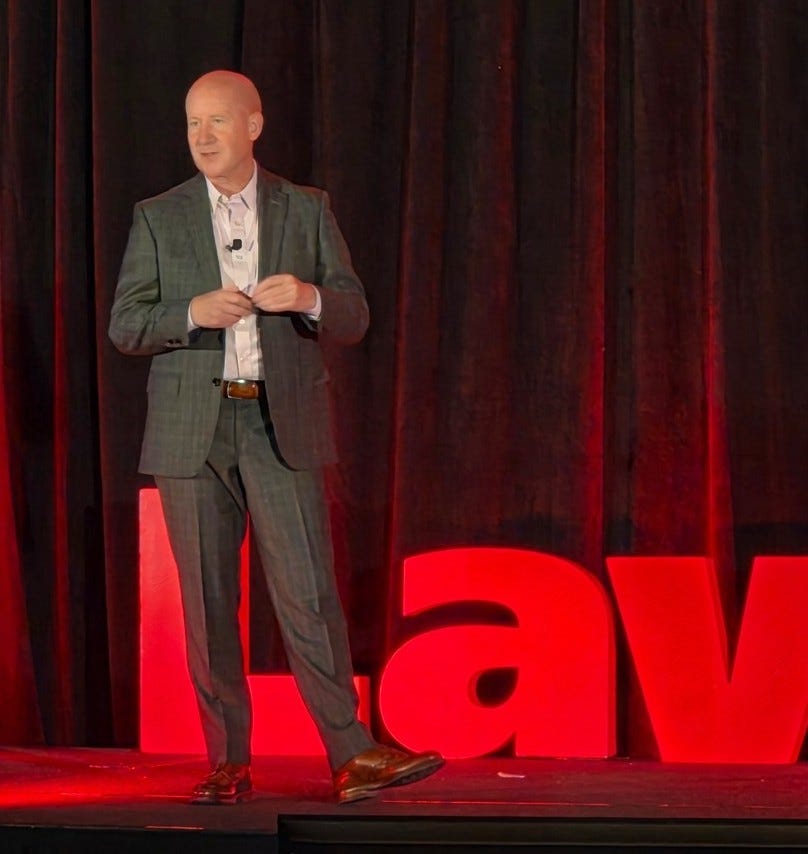
I can be rightly censured for not keeping up a steady stream of posts. I can also be censured for packing way more material into conference presentations than is necessary, wise or even polite. Guilty as charged, your honour.
These charges can be traced back to a common cause. I tend to do a lot of work behind the scenes so that when something surfaces there is a lot behind it. This is both a good thing and a challenge.
It turns out that the very same charges can be levelled at the concept of 'Content Solutions', and indeed at the implementation of any one Content Solution, and for much the same reason.
The phrase 'Content Solutions' is one I have thrown around for over 30 years. During that time, I have defined them in various ways. One of my favourites is also the most impish:
Content Solutions are Content Management Systems that do something useful
My colleagues who offer or implement Content Management Systems bristle at this definition, taking it to be a criticism of what they provide. There is a little sting in it to be sure but it need not be taken too negatively. One way of reading it is that a Content Solution is something we realize in part by implementing and leveraging a Content Management System (CMS). Indeed, given the generally moribund nature of the CMS market, these colleagues may want to embrace, rather than resist, this positioning.
In preparation for a recent conference presentation, I took a new and more grounded approach to defining what a Content Solution is and elaborating on why the concept of a Content Solution is important and timely. As touched on in my previous post, I grounded this effort in an analysis of 100 projects I have undertaken in the last 35 years. This analysis was performed with the help of AI assistants working with my growing text archive (now standing at over 650,000 words). One of the artifact types in my archive is 'project experience' and this type is associated with an intentional structuring of some of the content so that more useful analysis can be performed and more interesting visualizations (such as that below) generated.
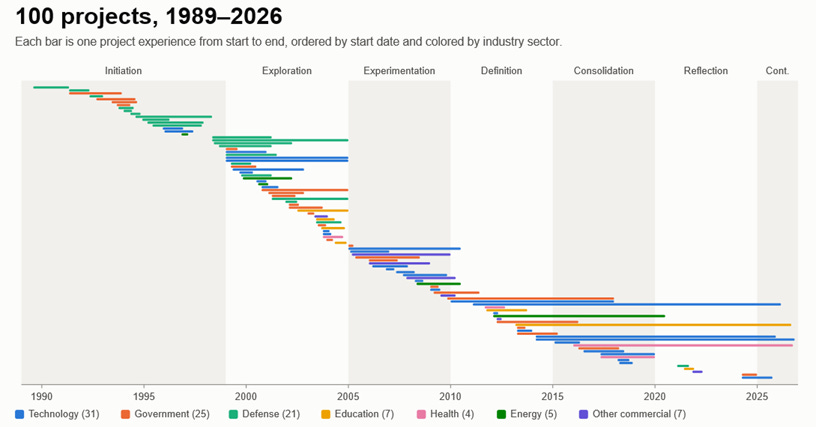
An analysis of these 100 projects brought me back to the idea of Content Solutions. It turns out that very few of the projects in my past could be classified simply as CMS implementations. The vast majority of the projects would be more accurately classified as business application implementations that succeeded because they leveraged the content assets the organizations had at their disposal. The distinction being made here is vital. Content Solutions are business applications.
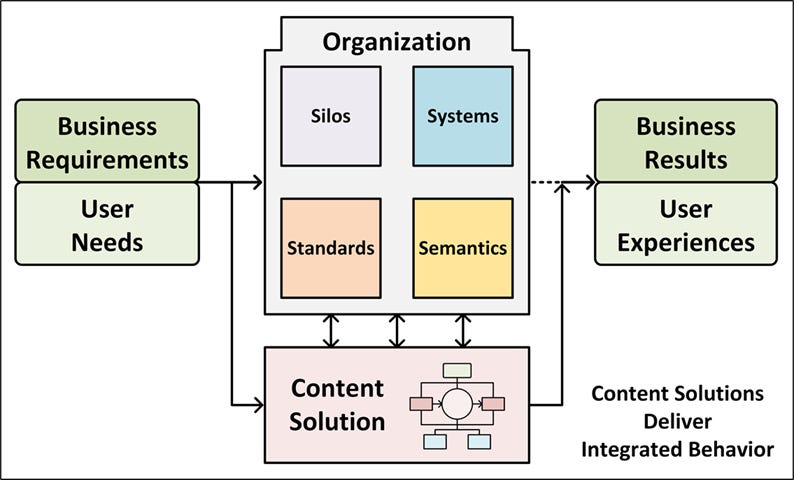
The one solution that I have invented 100 times, as Claude so accurately framed it, is this. Content Solutions leverage the language that people use to describe what they need, what they are doing, and what commitments they are making. These solutions leverage this language to re-integrate what an organization does into coherent behavior that its value stakeholders, its customers and users, derive benefit from.
Back to the criticisms often levelled at me, and the reason behind it, there is a lot behind this positioning. More indeed than we can go into in one post.
In my LavaCon 2026 presentation, I structured my talk around the narrative storyline of the 1984 movie The Neverending Story. One consequence of adopting this storyline was that it forced me to decide what is the real threat we are facing and to which we must respond. In the movie, it is the mysterious 'Nothing' that is destroying Fantasia, the world of human fantasies. One temptation was to position Artificial Intelligence (AI) as the Nothing. But that was not right. Not right at all.
In the world of organizations, the real threat is to be found in 'unmanaged specialization'. In my talk, I phrased this threat as 'over-specialization' but that is not quite right either. Unmanaged specialization is preferrable because part of my message, and here I overtly cited Peter Drucker, was that specialization is unavoidable and indeed with the evolution of society it can only be expected to increase over time.
In the past I have framed 'unmanaged specialization' with a word coined for the purpose: Barnaclization. This is a concept that has proven useful over the 25 years I have been using it. Its definition is worthwhile pondering:
Barnaclization is a process whereby individually beneficial innovations combine to degrade and eventually destroy a system
Content Solutions have emerged in my experience as a way to bridge the various components of an organization to achieve an integrated result. These components, whether they are silos, systems, standards or semantics, will inescapably inform the products and services of the organization, effectively its behavior, in accordance with Conway’s law (which I noted has antecedents stretching back hundreds of years before Conway). Content Solutions tap into the wellsprings of knowledge that operate within and across these organizational components. Once again, there is more here than we can really grapple with right now.
Content Solutions have been a persistent interest for me, even a passion, because they show us that in the language people use to get things done there is more than meets the eye. The same is true in how AI is learning more from our texts than we fully appreciate. These insights are related but we will need to come back to this at another time.
Interesting concepts here, Joe.
I often ask myself if I overcomplicate content solutions by trying to take too many concerns into consideration. My drive as an information architect has always been to try to maximize operational benefits for the authors to provide better, more consistent results across teams. I work to achieve this by pushing down the complexity on the systems supporting the authors. This in turn, does not endear me to systems vendors or those tasked with maintaining those systems.
Despite trying to incorporate off-ramps for normalization, this can lead to fragility in the solutions we build. This is the fine line I walk to build scalable solutions for my clients. At least now I have a phrase for this concept. I can ask my colleagues that are peer reviewing my solution designs to assess the levels of barnaclization in the design and recommend where this can be reduced.
I also want to add that your statement that "AI is learning more from our texts than we fully appreciate" is insightful. It amazes me that people put so much stock in the power to the neural networks and computing power for the wonder of AI and put so little stock in the power of human language. It is the hidden complexities and nuance of language that makes AI powerful. As a professional technical writer, I feel that we should be embracing our love of language and its awesome power to enable both humans and machines.