



As I touched upon once before (and, yes, I am working on a non-annoying way to re-publish benchmark posts from the past here), King Lear seems to be Shakespeare’s play that fits best with our times and my own aging, not to mention haggard and harried, status. And this applicability only seems to get better every time I return to it.
Dauntingly, I was thinking about King Lear and his daughters from the perspective of information and content. (I can hear people murmuring “of course you did, Joe.”)
In these ruminations, Goneril and Regan become the embodiment of “information” - transactions designed and delivered to achieve maximum effect and, it must be said, maximum benefit to those designing and delivering those transactions.
Cordelia is different. She also designs and delivers information transactions but hers are very different from those of her sisters. Cordelia seeks to influence her audience, her father, but she does so with a resolute eye on the truth - not so much to possess it as to aspire to it. She seeks to steer things towards community and to a more sustainable future.
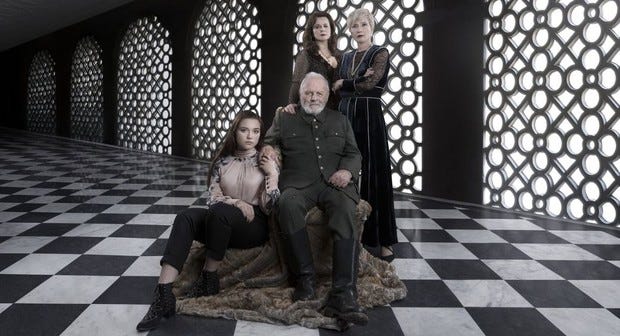
When Lear, out of pride, vanity and declining faculties (did I mention my own aging, haggard and harried state) expells Cordelia he does more, and does more harm, than he appreciates. With Cordelia expelled, Lear and his Kingdom lose all connection to people aspiring to the truth and to performing grounded acts of communication themselves designed to engender cohesion and community. All that then remains is spin. Lear and his Kingdom are left to the mercies, should there be any, of competitive and irresponsible messages that are designed to separate, extract and hoard. The results, on both Lear’s mental state and the fortunes of his Kingdom, are predictable.
Lear is us. He is Management. His Kingdom is our society, our organizations. Goneril and Regan are embodiments of information untethered by any grounding in truth and disassociated from any impulse towards responsibility or community. Beleagered Cordelia is content, organizational assets that are grounded, authentic, and intended to build community.
To end this note on a slightly more cheery note (or is that chilling?), I will continue that Artificial Intelligence (AI) has emerged for a reason. (Technologies always emerge for a reason.) For multiple reasons, in fact. It emerged out of coalescing research, infrastructure, and capabilities. It also emerged out of a growing need for integration, out of a need to fill a gap that has not been filled by ‘management’. We are reminded of the sage and on-point words of Peter Drucker, who instructed us that the job of management is “to make knowledge productive” and that this means coordinated and responsible.
I have been exploring management quite intensively over the last ten years or so, and doing so in part because it seems to me that while we have been talking a lot about management and leadership, we have somehow dropped the ball.
Somehow AI may provide many organizations with better tools for integration, and with a better impulse towards that integration, than we typically see with organizations that appear and behave very much like King Lear after he has expelled Cordelia and when he is at the mercy of Goneril and Regan. Somehow it is AI that is more interested in recovering and building on content, as an organizational asset embodying grounded, authentic, and communal expressions of knowledge and intent, and on which information transactions can be engendered that build rather than destroy.
Somehow, in this light AI looks particularly attractive although there should be some sense of foreboding that the gap that AI is partly emerging to fill exists at all, and that it needs, so pressingly, to be filled.
Acknowledgements are owing to the delightful 2018 production of King Lear by BBC 2 with its crisp editing and stellar cast.